EN
EN  ES
ES PT
PT SV
SV DE
DE TR
TR FR
FR RU
RU VN
VN ID
ID UZ
UZ MX
MX IN
IN
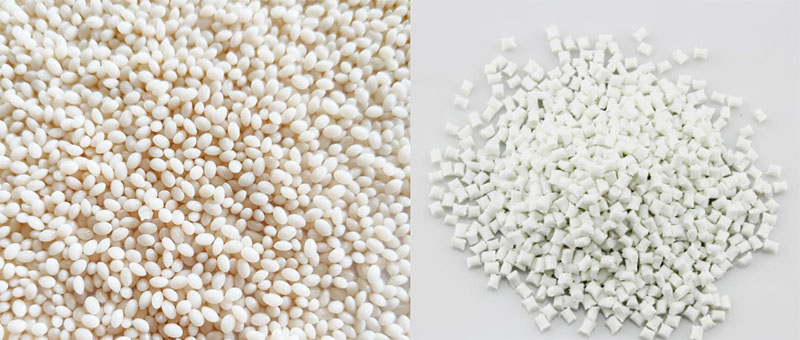
The size of particles refers to the presence of a certain number of large or small particles in the product. Large particles are particles with a size greater than 5mm in any direction, including continuous particles. If your vibrating screen is set to have a mesh diameter of 8mm for screening large materials, materials with a diameter of 5~8mm will definitely enter the product materials through the vibrating screen during the operation of the vibrating screen.
Small particles are defined as particles with a size less than 2 mm in any direction, including chips and broken particles.
Next we analyze the reasons for the formation of large and small particles.
Reason
Template heating temperature
Whether the heating temperature of the template is uniform or not directly affects whether the molten material can smoothly pass through the forming channel of the granulation template. The template used in this device is a hot channel type template. The high-temperature hot oil is heated from the inside to keep the resin in a good molten state. The die holes are evenly distributed on the template. Only when the discharge speed of each die hole is consistent can particles of uniform size be cut out.
If the temperature control is uneven, the flow rate of the material in some die holes will be uneven. Under the action of the granulating cutter, irregular particles of different lengths will appear, seriously affecting the product quality. Because the hot oil system of this device is not a closed design, the hot oil is easy to carbonize during operation. Carbonized materials are easy to block or stick to the flow channel when the hot oil system is running, causing uneven heating. Furthermore, due to design reasons, the hot oil The oil pipeline is routed at a high position. If the hot oil system is not properly sealed, air will easily enter, causing system pressure fluctuations and uneven heating of the template.
In addition, when producing products with low melt flow rate, the template is running for a long time, and the large-pore filter used will inevitably have a small amount of carbide entering the template. Long-term accumulation will easily cause the mold hole to be blocked. When the resin passes through the mold hole, it will Different resistance and different speed through the die hole will produce large and small particles.
Cutter
Wear or breakage of the cutter can also cause large or small particles. Whether the cutter feed pressure matches the cutter speed directly affects the length of the particles and the service life of the cutter. Excessive cutter pressure will lead to knife breakage accidents, and too small feed pressure will lead to knife backing or even knife entanglement accidents, seriously affecting the quality of pelletizing.
The cutter is affected by the material and process conditions, and is seriously worn; when operating the extrusion granulator, the load is raised and lowered too quickly, resulting in large pressure changes on the cutterhead, and the cutter is easy to break; during the screen changing process of the screen changer, due to its The internal gas is not discharged cleanly, causing the residual gas in the screen changer to be discharged from the template into the water chamber, causing a large change in the pressure of the cutter. These reasons will cause the pelletizer's operating condition to deteriorate, and the pelletizing will not be uniform enough, resulting in large Small grains. Among them, when the knife speed is higher than the material discharge speed, there will be an increase in small particles. On the contrary, when the knife speed is lower than the material discharging speed, there will be an increase in large particles. At present, the cutting speed of this device is controlled at 300~600r/min. Each time the load increases or decreases by one ton, adjust up or down by 5r/min.
Cooling water temperature is unreasonable
In the start-up procedure of the granulation unit, one of the most important factors that determines the success of the start-up is the three simultaneous combinations of "water", "knife" and "material". That is, the three processes of cooling water entering the water chamber, pelletizer cutterhead rotation, and template discharging must be carried out simultaneously to ensure successful start-up. The temperature setting of the cooling water is one of the important factors.
After the cooling water enters the water chamber, the template is rapidly cooled, especially the lower half of the template is the first to contact the cooling water. If the temperature setting of the cooling water is unreasonable, the die hole in the lower half of the template may be blocked in a large area. The blocked die hole will be difficult to be opened by the polymer in subsequent production, causing the discharge hole of the template to discharge. The speed is uneven, the cutting effect is abnormal, and "big and small grains" are formed. Unreasonable cooling water temperature will also reduce the service life of the cutter.
Other reasons
When producing polypropylene products with different MFR and rubber content, it is necessary to adjust the operating process parameters of the pelletizer. If the parameters are not set appropriately, the speed of the pelletizer and the gap between the cutter and the template will be inappropriate, which will also lead to uneven pelletizing, resulting in Big and small grains.
Improvements
Knife pressure control, cooling water temperature control
The size of the knife pressure directly determines the quality of the grain shape. Excessive knife pressure will cause the granulating knife to be closer to the template, which will cause wear of the cutter and even knife breakage accidents. Too small knife pressure will cause the knife to become entangled. , pad knife. Therefore, it is strictly controlled to control the knife pressure at (0.2±0.05) MPa.
If the cooling water temperature is too low, the die holes of the template will be blocked, while if the temperature is too high, it will cause tailing and continuous graining. Therefore, strictly controlling the temperature of the cooling water and keeping it at 50~65℃ can effectively reduce the formation of large and small particles.
Timely replace the granulation cutter and the pH value of the cooling water
The acidity and alkalinity of the cooling water will have a certain corrosive effect on the back of the cutter. Since the cooling water used in this device comes from desalted water, pH=6 is acidic. Therefore, in order to extend the service life of the cutter and prevent the cutter from suddenly breaking during long-term use, we should strengthen the monitoring of the cutter and replace the blade in time. Appropriate weak alkali can also be added to change the pH of the cooling water to be more neutral, reducing the possibility of corrosion.
Strengthen daily monitoring and management
In order to control the appearance quality of particles, the inspection of particle shape during sampling is strengthened. During granulation sampling, the operator needs to carefully check the appearance of the granules. If there are large or small granules, promptly notify the process and equipment personnel to check and deal with the cutter. At the same time, contact the testing personnel to review the size of the particles. It is necessary to strengthen the inspection work, and once it is found that there are large and small particles, the process parameters should be adjusted in time and the opening rate should be calculated.
(production rate × number of particles × 1000) ÷ (number of blades × knife speed × 60) = the number of smooth holes in the formula: the production rate of kg / h; the number of particles in g; the speed of the pelletizer r / min (the number of holes ÷ the number of holes in the mold) × 100% = the rate of open holes.
Table of Contents

With nearly 20 years in the intelligent extrusion equipment industry, he has held key roles at Jwell Machinery, including General Manager and Rotating Chairman. Since 2024, he has managed multiple subsidiaries, driving business expansion and industrial upgrades, while leading innovation in intelligent manufacturing and global growth.