EN
EN  ES
ES PT
PT SV
SV DE
DE TR
TR FR
FR RU
RU VN
VN ID
ID UZ
UZ MX
MX IN
IN
In addition to many differences in raw materials and specifications, geomembranes are also produced in two ways, namely film blowing and lamination. The corresponding processes are blow molding and flat extrusion.The geomembranes produced by the two production processes have certain differences and each has its own advantages.
Let’s analyze the advantages and disadvantages of the two production processes.

Laminated film
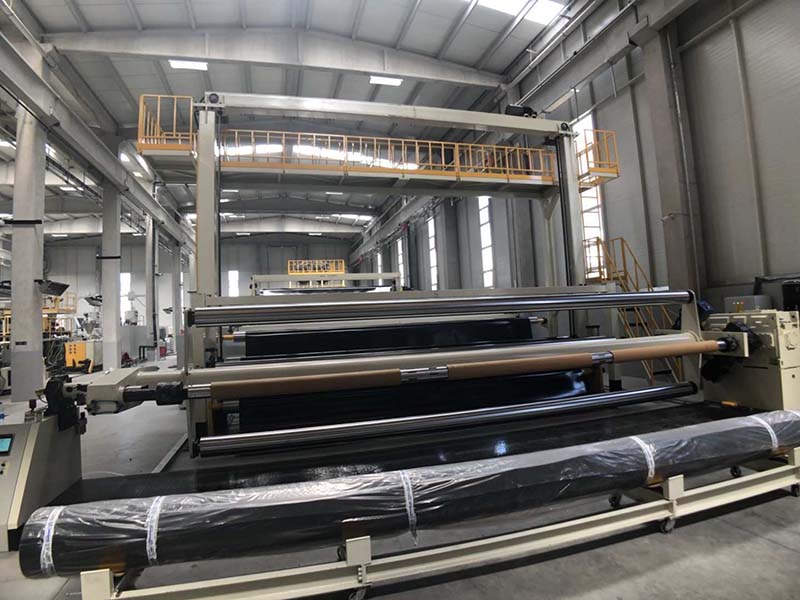
Laminated film, also known as cast film #machine, is a non-stretched, non-directional cast film produced by melt casting and quenching. There are two methods: single-layer casting and multi-layer co-extrusion casting.Its production process is as follows: first is the ingredients. Raw materials such as high-density polyethylene particles, color masterbatches, and carbon black are mixed in a certain proportion, stirred evenly, and then poured into the silo. Then the raw materials are heated through the extruder. It melts into a fluid and is extruded through the screw extrusion at the film lip. It is then pulled through steel rods or rubber rollers to form and cool. The gap size of the pressure roller is the thickness of the geomembrane. Finally, it is pulled and trimmed into a roll.
The advantages of lamination are high production efficiency, different thicknesses can be adjusted at will, low cost, and the finished geomembrane has high gloss and good flexibility. The minimum thickness can be 0.2mm. The disadvantage is that the thickness is not uniform enough.
Blowing film
The production process of blown film is a three-layer co-extrusion blow molding production method. The production process is to feed the raw materials into the blow molding machine die through three heating screws, where they are heated and melted into melts. These melts are melted under pressure. The extruder head is extruded and formed into a cylindrical shape at the position of the machine head. The compressed air blows upward through the die head to form a film bubble of a certain diameter. It is stretched upward by the traction roller and cooled to form a geomembrane. After curling, it extends downward. After traction and segmentation, the geomembrane is unfolded through the membrane frame and finally rolled into a roll.
The advantages of the blow molding process are uniform thickness of the geomembrane, high tensile strength, and stable film quality. The disadvantages are high production costs, no price advantage, and the gloss and elongation are not as good as those of lamination.
When using the same raw materials, the geomembranes produced by the two processes have their own advantages and disadvantages. Due to its low cost and good product flexibility, lamination is currently used more in tunnel projects and civil engineering, while blow molding is more suitable for landfills, reservoirs, and oil tank areas because of its uniform product thickness and high quality stability. Penetration and other projects with higher quality requirements. But no matter what kind of process, as long as it is produced according to standards, the quality will be up to standard. We can choose the right one according to the engineering needs.
Table of Contents

With nearly 20 years in the intelligent extrusion equipment industry, he has held key roles at Jwell Machinery, including General Manager and Rotating Chairman. Since 2024, he has managed multiple subsidiaries, driving business expansion and industrial upgrades, while leading innovation in intelligent manufacturing and global growth.