EN
EN  ES
ES PT
PT SV
SV DE
DE TR
TR FR
FR RU
RU VN
VN ID
ID UZ
UZ MX
MX IN
IN
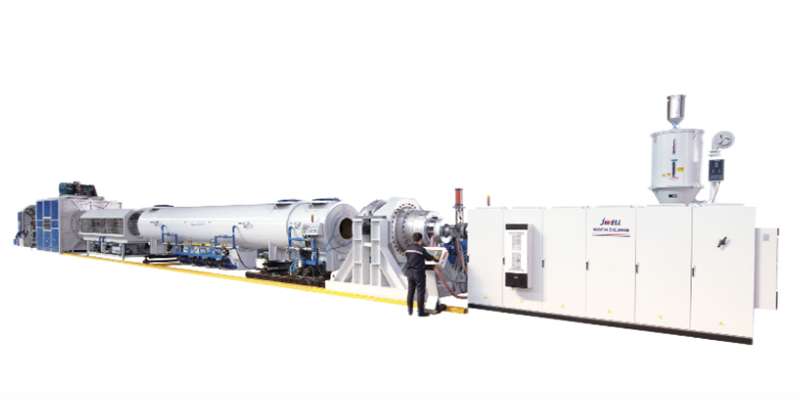
In the technological innovation of water resource transportation, HDPE (high-density polyethylene) water supply pipes, with their excellent corrosion resistance, flexibility, and environmental friendliness, are gradually replacing traditional metal and concrete pipes, becoming the mainstream choice for water supply network construction. The core equipment supporting the large-scale, high-quality production of HDPE water supply pipes—the HDPE water supply pipe extrusion production line—has become a key force driving the upgrading of water supply networks due to its precise process control, efficient production capacity, and flexible adaptability. This article will delve into the core advantages of the HDPE water supply pipe extrusion production line and comprehensively review its application scenarios in various fields, showcasing its significant industrial value.
Core Advantages of HDPE Water Supply pipe extrusion line
The product boasts superior quality and is well-suited to the core needs of water supply networks.
The core competitiveness of the HDPE water supply pipe extrusion production line lies in its ability to maximize the performance advantages of HDPE raw materials, producing high-quality products that meet the stringent requirements of water supply networks. This production line employs a precise single-screw or twin-screw extrusion system, combined with a specialized HDPE raw material plasticizing process, ensuring thorough melting and uniform mixing of the raw materials, thus preventing defects such as bubbles and impurities from the source. The produced HDPE water supply pipes exhibit extremely strong corrosion resistance, withstanding the erosion of acids, alkalis, and microorganisms in water, requiring no additional anti-corrosion treatment. This solves the problems of easy corrosion in traditional metal pipes and easy scaling in concrete pipes, effectively ensuring water quality safety.
Simultaneously, through optimized mold design and a cooling and shaping system, the production line can precisely control the uniformity of pipe wall thickness and the accuracy of outer diameter, giving the product excellent mechanical properties. The HDPE water supply pipe has an elongation at break of over 300%, exhibiting extremely high flexibility and resistance to brittleness in low-temperature environments. It can adapt to geological changes such as earthquakes and ground subsidence, reducing the risk of pipe rupture and leakage. Its high ring stiffness allows it to withstand certain soil pressure and external loads, adapting to different burial depths. In addition, the production line can produce water supply pipes of different specifications (diameter 20mm-1200mm) and different pressure levels by adjusting process parameters, from small-diameter pipes for home decoration to large-diameter pipes for municipal trunk networks, all of which can achieve high-quality mass production.
High and stable production efficiency, achieving optimized cost control.
The HDPE water supply pipe extrusion line achieves breakthroughs in both production efficiency and cost control through fully automated design and process optimization. In terms of the production process, the line adopts a continuous operation mode of "raw material conveying—drying pretreatment—melt extrusion—die forming—cooling and shaping—traction cutting—online inspection—finished product winding," with each link seamlessly connected by an intelligent control system, significantly reducing manual intervention. The core equipment, the extruder, features a high-efficiency screw design with a reasonable screw length-to-diameter ratio, improving raw material plasticizing efficiency by more than 20%. A single production line can achieve a daily output of several thousand meters, meeting the centralized supply needs of large-scale municipal projects.
In terms of cost control, the production line's advantages are reflected in multiple dimensions: Regarding raw material utilization, continuous extrusion reduces raw material loss, allowing for the recycling and reuse of scraps, resulting in a raw material waste rate of less than 3%; in terms of energy consumption control, the use of energy-efficient motors and optimized temperature control systems reduces unit product energy consumption by 15%-25% compared to traditional production lines, especially with the adoption of circulating water cooling technology in the cooling process, further reducing energy consumption; regarding labor costs, the fully automated production mode requires only 2-4 operators per production line, reducing labor input by more than 50% compared to traditional semi-automated production lines. Furthermore, the online detection system equipped on the production line can monitor pipe wall thickness, outer diameter, pressure resistance, and other indicators in real time, promptly eliminating unqualified products, reducing subsequent rework costs, and further improving production efficiency.
The Multiple Applications of HDPE Water Supply Pipe Extrusion Line
Municipal Water Supply Sector: Building a Safe Urban Water Supply Network
Municipal water supply projects are the core application area of HDPE water supply pipe extrusion production lines. The pipes produced, due to their superior performance, have become the preferred choice for urban water supply network construction. In the construction of main urban pipelines, large-diameter HDPE water supply pipes (500mm and above) offer advantages such as high flow rate and low resistance, enabling efficient water delivery and reducing pressure loss. Their flexibility and impact resistance allow them to adapt to complex geological environments during urban road construction, reducing the risk of pipe damage caused by ground subsidence and vehicle loads. In the construction of branch networks in residential and commercial areas, small- and medium-diameter HDPE water supply pipes are lightweight and easy to connect. Using hot-melt butt welding or electrofusion connection technologies, the joint strength is higher than that of the pipe body, effectively avoiding leakage risks and ensuring the safety of residents' water use.
Furthermore, HDPE water supply pipes are widely used in the upgrading and renovation of urban water supply networks. Traditional metal water supply networks suffer from water quality degradation due to corrosion and scaling, while the corrosion resistance and smooth inner wall of HDPE water supply pipes effectively solve this problem, eliminating the need for frequent pipe replacements and reducing network maintenance costs. In emergency water supply projects, HDPE water supply pipes can be laid and connected quickly to ensure temporary water supply and improve the emergency response capability of urban water supply systems.
Rural water supply sector: Contributing to safe drinking water for rural revitalization
With the advancement of the rural revitalization strategy, rural drinking water safety projects have become a key livelihood project. HDPE water supply pipes, produced by extrusion lines, are widely used in rural water supply due to their adaptability to the rural environment. Rural water supply networks cover a wide area and have complex terrain. HDPE water supply pipes are lightweight (only 1/8 the weight of steel pipes and 1/10 the weight of concrete pipes), facilitating transportation and field installation, significantly reducing construction difficulty and costs. Their strong corrosion resistance allows them to adapt to different water quality environments in rural areas, including groundwater and surface water, preventing pipe corrosion and water pollution. In water supply projects in remote mountainous areas, the flexibility of HDPE water supply pipes can adapt to undulating terrain, reducing the need for pipe bends and lowering water flow resistance.
Furthermore, in the construction of centralized rural water supply stations, HDPE water supply pipes are used for water source transportation and reservoir connections. Their excellent sealing properties prevent secondary pollution and ensure safe drinking water for rural residents. In the field of agricultural irrigation, small and medium diameter HDPE water supply pipes can be used in field irrigation networks. They have strong anti-aging properties, can adapt to the environment of outdoor laying, and have a service life of more than 50 years, reducing the frequency of replacement of irrigation networks.
HDPE water supply pipe extrusion lines play an irreplaceable role in various fields such as municipal water supply, rural water supply, industrial and special water supply due to their core advantages of superior product quality, high and stable production efficiency, and convenient operation and maintenance. With the advancement of my country's water resource optimization and allocation projects, the acceleration of integrated urban and rural water supply construction, and the continuous improvement of environmental protection requirements, the market demand for high-quality HDPE water supply pipes will continue to grow, providing ample room for technological upgrades of HDPE water supply pipe extrusion production lines. In the future, with the deep integration of intelligent and green technologies, HDPE water supply pipe extrusion production lines will further achieve the goals of "improving quality and efficiency, reducing costs and emissions," providing stronger equipment support for the high-quality development of my country's water supply industry.

Table of Contents
- Core Advantages of HDPE Water Supply Pipe Extrusion Line
- Municipal Water Supply Sector: Building a Safe Urban Water Supply Network
- Rural water supply sector: Contributing to safe drinking water for rural revitalization
- The product boasts superior quality and is well-suited to the core needs of water supply networks.
- High and stable production efficiency, achieving optimized cost control.
- The Multiple Applications of HDPE Water Supply Pipe Extrusion Line

With nearly 20 years in the intelligent extrusion equipment industry, he has held key roles at Jwell Machinery, including General Manager and Rotating Chairman. Since 2024, he has managed multiple subsidiaries, driving business expansion and industrial upgrades, while leading innovation in intelligent manufacturing and global growth.