EN
EN  ES
ES PT
PT SV
SV DE
DE TR
TR FR
FR RU
RU VN
VN ID
ID UZ
UZ MX
MX IN
IN
Since its inception, the twin-screw #extruder has been widely used in the field of plastic modification and is the core equipment in the field of modification.Every modification factory takes great care of the twin-screw #extruder, but in its daily work, it is inevitable that it will encounter equipment loss and repair.So in order to avoid or reduce losses, how to repair after a failure, Xiaobian will introduce some little knowledge about the maintenance and repair of the extruder.
Maintenance of twin-screw #extruder
Debris is not allowed to be entrained in the material, and hard substances such as metal and sand and gravel are strictly prohibited from entering the hopper and barrel; when opening the suction chamber cover, foreign objects should also be strictly prevented from falling into the barrel; the extruder should be kept warm for sufficient time after heating up, and the rotation should be brisk before starting the operation; the screw is only allowed to start at low speed, and the idling time should not exceed 2 min. The feeder should be fed by starvation before gradually increasing the speed.
The oil and lubricating oil should be replaced once after every 4000h of operation. If the main motor is a DC motor, the motor carbon brush should be checked once a month and recorded, and the carbon brush should be replaced if necessary; the electric control cabinet should be purged once a month, and the wear of the screw and barrel should be checked quarterly, and records should be made; the gears, bearings and oil seals of the gearboxes should be checked once a year; when the machine is down for a long time, the machine should be treated for anti-corrosion and anti-fouling.
Repair of twin-screw #extruder
The screw rotates in the barrel, and the friction between the material and the two causes the working surface of the screw and the barrel to gradually wear out: the diameter of the screw gradually shrinks, and the diameter of the inner hole of the barrel gradually increases.In this way, the gap between the mating diameter of the screw and the barrel increases a little bit as the two gradually wear out.However, since the resistance of the nose and the shunt plate in front of the barrel has not changed, this increases the leakage flow of the extruded material as it advances, that is, the flow of the material from the diameter gap to the feed direction increases.As a result, the production volume of the #extruder decreased.This phenomenon also increases the residence time of the material in the barrel, causing the material to decompose.If it is polyethylene, the hydrogen chloride gas produced by the decomposition strengthens the corrosion of the screw and barrel.
If there are fillers such as calcium carbonate and glass fiber in the material, it can speed up the wear of the screw and barrel.Because the material is not plasticized evenly, or metal foreign objects are mixed into the material, the rotating torque force of the screw suddenly increases, and this torque exceeds the strength limit of the screw, causing the screw to twist.This is an unconventional accident damage.
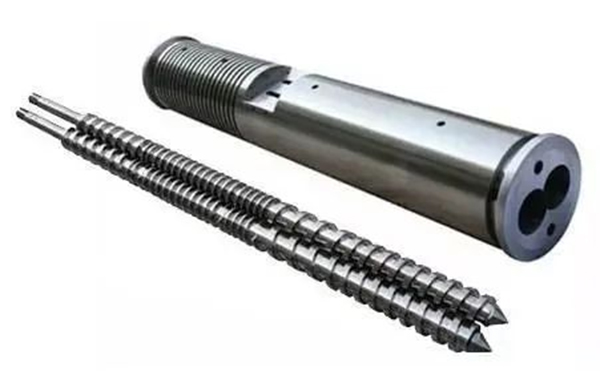
The twisted screw should be considered according to the actual inner diameter of the barrel, and the outer diameter deviation of the screw should be manufactured according to the normal gap with the barrel.
After the surface of the thread with the reduced diameter of the worn screw is treated, the wear-resistant alloy is thermally sprayed, and then ground to size.This method is generally processed and repaired by professional spraying factories, and the cost is relatively low.
Surfacing wear-resistant alloys on the threaded part of the worn screw.According to the degree of screw wear, surfacing is 1~2mm thick, and then grinding the screw to the size.This wear-resistant alloy is composed of materials such as C, Cr, Vi, Co, W and B, which increases the wear resistance and corrosion resistance of the screw.Professional surfacing plants have a high cost for this kind of processing, except for screws with special requirements, which are generally rarely used.
Hard chrome plating on the surface of the screw can also be used to repair the screw. Chromium is also a wear-resistant and corrosion-resistant metal, but the hard chromium layer is easier to fall off.
For a barrel with an increased diameter due to wear and tear, if there is still a certain nitriding layer, the inner hole of the barrel can be directly bored and ground to a new diameter, and then a new screw can be formulated according to this diameter. The inner diameter of the barrel is machined and trimmed to re-cast the alloy, the thickness is between 1~2mm, and then it is finished to the size. Under normal circumstances, the homogenization section of the barrel wears out quickly. This section (take 5~7D length) can be bored and trimmed, and then equipped with a nitriding alloy steel bushing. The diameter of the inner hole refers to the diameter of the screw, and it is left in the normal mating gap for processing and preparation.
Table of Contents

With nearly 20 years in the intelligent extrusion equipment industry, he has held key roles at Jwell Machinery, including General Manager and Rotating Chairman. Since 2024, he has managed multiple subsidiaries, driving business expansion and industrial upgrades, while leading innovation in intelligent manufacturing and global growth.