EN
EN  ES
ES PT
PT SV
SV DE
DE TR
TR FR
FR RU
RU VN
VN ID
ID UZ
UZ MX
MX IN
IN

Advantages of ABS Sheet Extrusion Lines
Excellent Product Performance
ABS sheet combines the chemical resistance of acrylonitrile, the toughness of butadiene, and the processability of styrene. Extrusion lines consistently produce sheet with a smooth surface, uniform color, and balanced mechanical properties (impact resistance, abrasion resistance, and moderate rigidity). Formula adjustments can also be made to achieve flame retardancy, antistatic properties, and heat resistance to meet diverse application requirements.
High Production Efficiency and Stable Process
Modern ABS sheet extrusion lines typically utilize single-screw or twin-screw extruders, coupled with precision molds and temperature control systems. These enable continuous production at speeds of 10-60 m/min, consistent sheet thickness (controllable to within ±0.05 mm), and low scrap rates. Furthermore, the lines can be integrated with automatic roll changing and in-line cutting devices to further.
Enhance production efficiency. Strong Processing Adaptability
ABS sheet is easily adaptable to secondary processes such as thermoforming (blister forming, hemming), welding, printing, and coating. Extrusion lines can produce sheets in varying thicknesses (0.1-10mm) and widths (up to 2000mm or more) to meet diverse product specifications.
Controllable Costs and High Cost-Effectiveness
Compared to materials like metal and glass, ABS sheet has moderate raw material costs, low energy consumption during extrusion, and lightweight finished products, with low transportation and processing costs. Its overall cost-effectiveness surpasses many alternative materials.
Main Applications of ABS Sheet Extrusion Lines
Packaging
Food Packaging: Used in the production of disposable food trays, lunch boxes, beverage cups, etc. (must meet food-grade standards) due to its smooth, easy-to-clean surface and low-temperature resistance (suitable for refrigerated packaging).
Industrial Packaging: Used in the production of turnover trays and packaging boxes for electronic components and precision instruments, leveraging its impact resistance to protect products from bumps and dents.
Daily Necessities and Consumer Electronics
Daily Necessities: Such as refrigerator liners, washing machine panels, toy housings, and bathroom accessories. These products are thermoformed into complex shapes, achieving both aesthetics and durability.
Consumer Electronics: Used in the linings of mobile phone and computer housings, keyboard bases, etc., leveraging its rigidity and colorability to achieve a variety of surface treatments (such as spray painting and electroplating).
Automotive and Transportation
Used in automotive interior parts (such as instrument panel covers and door trims), trunk linings, and sun visors. Its impact resistance, aging resistance, and lightweight nature reduce vehicle fuel consumption.
In short, ABS sheet extrusion production lines occupy an important position in packaging, home appliances, automobiles and other fields due to their product versatility and process flexibility. With the development of modification technology, their application scenarios will also expand to high-end manufacturing (such as new energy accessories) and other fields.
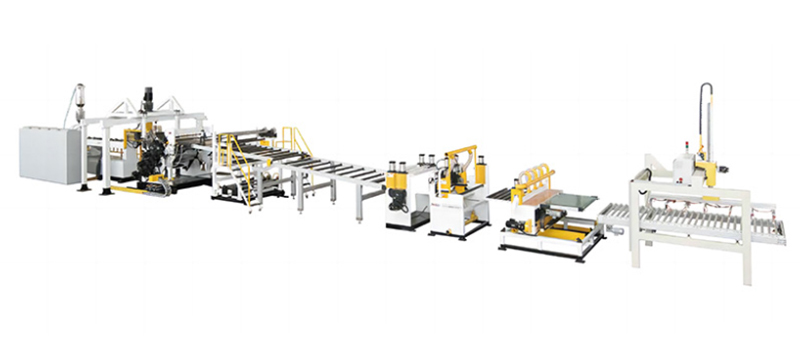
| Model | JW120/70/60-2200 | JW120/60/45-1800 | JW160/60-2200 |
| Material | ABS,PMMA | ABS,PS,HIPS | ABS,PS,HIPS |
| Extruder specification | Ø120/38,70/35,60/35 | Ø120/38,60/35,45/35 | Ø160/38,60/35 |
| Co-extrusion layer | A/B/C/B/A | A/B/C | A/B,A/B/A |
| Products width | 2200mm | 1800mm | 2200mm |
| Products thickness | 2-8mm | 1-6mm | 1-6mm |
| Capacity (Max.) | 600Kg/h | 550Kg/h | 1200Kg/h |

With nearly 20 years in the intelligent extrusion equipment industry, he has held key roles at Jwell Machinery, including General Manager and Rotating Chairman. Since 2024, he has managed multiple subsidiaries, driving business expansion and industrial upgrades, while leading innovation in intelligent manufacturing and global growth.