EN
EN  ES
ES PT
PT SV
SV DE
DE TR
TR FR
FR RU
RU VN
VN ID
ID UZ
UZ MX
MX IN
IN
With the increasing demand for "lightweight, high-performance, and aesthetically pleasing" panels in the home appliance industry (especially in the refrigerator sector), and the pursuit of "easy-to-clean, anti-aging, and personalized" sanitary ware panels in the sanitary ware industry, traditional single-material production lines can no longer meet the production needs of multi-category and multi-performance products. At the same time, in order to reduce production costs and improve production efficiency, downstream enterprises are in urgent need of composite extrusion equipment that is "multi-functional, precise and controllable, green and efficient".
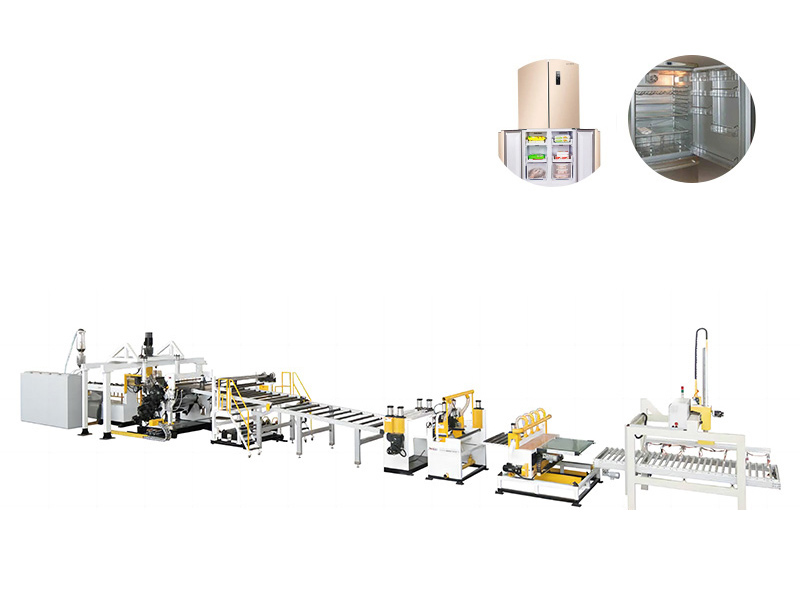
Thus, the ABS, HIPS, PMMA Refrigerator Plate, Sanitaryware Plate Extrusion Line has emerged.It not only adapts to the processing characteristics of the three mainstream polymer materials but also covers the two core application scenarios of refrigerators and sanitary ware. This line fills the equipment gap in "multi-material + multi-category" integrated production and helps enterprises achieve product structure upgrading and production capacity optimization.

Production process introduction: integrated intelligent, simple and efficient
Jwell ABS,HIPS,PMMA Refrigerator Plate,Sanitaryware Extrusion Line.
1. Raw Material Pretreatment: ABS, HIPS, and PMMA pellets are dried separately (to remove moisture and prevent bubble formation during extrusion). Color masterbatches or functional additives (such as anti-scratch agents and anti-mildew agents) can be added according to product requirements. After thorough mixing, the mixture is sent to the storage bin.
2. Extrusion and Plasticization: The pretreated raw materials are fed into a precision screw extruder via an automatic feeding system. Through the action of high temperature (approximately 200-230℃ for ABS, 180-210℃ for HIPS, and 220-250℃ for PMMA) and shearing, the screw plasticizes the raw materials into a uniform molten state.
3. Die Forming: The molten material is fed into a customized flat die (the lip gap can be adjusted according to the width and thickness of the panel). A uniform panel blank is formed inside the die and smoothly extruded onto the conveyor rollers.
4. Cooling and Setting: The panel blank enters a multi-stage cooling water tank or a vacuum setting table. It is rapidly cooled by temperature-controlled cooling water (water temperature approximately 20-30℃), which sets the panel into a stable physical form while ensuring a smooth and flat surface.
5. Online Inspection and Cutting: The set panel passes through a thickness inspection device (with tolerance controlled within ±0.1mm) and a surface defect detection system. Qualified panels are cut by an automatic cutting machine according to the set dimensions (length can be customized on demand), while unqualified products are automatically diverted to the waste recycling system.
6. Post-treatment (Optional): According to customer needs, surface treatment can be performed on the panels, such as film lamination (to improve wear resistance), printing (to enhance decorativeness), or edge trimming. Finally, the finished panels are formed and sent to the finished product warehouse.
Advantages of ABS/HIPS/PMMA
ABS (Acrylonitrile-Butadiene-Styrene Copolymer)
● High Impact Resistance: The butadiene component in its molecular structure endows it with excellent impact resistance. It can withstand the collision of refrigerator door opening and closing as well as daily knocks on sanitary ware panels without being easily damaged.
● Low-Temperature Stability: It maintains stable performance within the temperature range of -40℃ to 80℃, fully adapting to the operating environment of refrigerator refrigerating/freezing compartments (with a temperature of approximately -25℃ to 10℃) and will not become brittle and crack due to low temperatures.
● Good Processability: It has excellent melt fluidity, so it can be easily made into panels of different thicknesses (1-10mm) through extrusion process. Moreover, secondary processing such as drilling, bending, and film lamination can be carried out subsequently, which meets the complex assembly requirements of refrigerator inner liners and door panels.
HIPS (High Impact Polystyrene)
● High Surface Flatness: After extrusion molding, its surface is smooth and free of defects. It can be directly used for refrigerator interior panels and sanitary ware auxiliary panels without additional polishing, reducing subsequent processing procedures.
● Excellent Cost Controllability: The raw material price of HIPS is lower than that of ABS and PMMA, and its processing energy consumption is relatively low. On the premise of ensuring basic performance (such as resistance to damp heat and deformation), it can effectively reduce the production cost of enterprises and is suitable for large-scale mass production.
● Strong Chemical Corrosion Resistance: It has good resistance to refrigerants and cleaning agents (such as neutral detergents) in refrigerators, as well as water stains and soap liquid in sanitary ware environments. It is not prone to discoloration or cracking after long-term use.
PMMA (Polymethyl Methacrylate, commonly known as "Acrylic")
● High Light Transmittance: Its light transmittance can reach more than 92%, which is close to that of glass, and its light scattering rate is low. It is suitable for making transparent drawer panels of refrigerators and decorative panels of bathroom mirror lights, combining practicality and aesthetics.
● Outstanding Aging Resistance: When exposed to sunlight (ultraviolet rays) or humid bathroom environments for a long time, it is not prone to yellowing or embrittlement. Its service life can reach 5-8 years, which is far longer than that of ordinary plastic panels.
● Easy Cleanliness: Its surface is dense and non-porous. Water stains and dirt can be easily removed with a damp cloth without residue, meeting the "easy maintenance" requirement of sanitary ware scenarios.
Technical advantages of Jwell ABS,HIPS,PMMA Refrigerator Plate,Sanitaryware Extrusion Line
1. Strong Customization Adaptability: It can customize screw parameters, die structure and cooling system according to customers' product specifications (panel width: 500-2000mm, thickness: 1-10mm), production capacity requirements (100-350kg/h) and material characteristics, realizing "one production line adapting to multiple product categories" without frequent equipment replacement.
2. Leading Technology of Core Components: It adopts the independently developed "high-efficiency mixing screw" by Jwell. Compared with conventional screws in the industry, its plasticizing efficiency is increased by 15%, and the material dispersion is more uniform, avoiding uneven performance of panels. Equipped with a "precision constant temperature die", the temperature fluctuation of the die lip is controlled within ±1℃, ensuring the panel thickness tolerance is ≤±0.1mm.
3. High Intelligence Level: It is equipped with Jwell exclusive "intelligent production management system", which can monitor real-time data such as extrusion temperature, pressure, panel thickness and production capacity, support remote diagnosis and parameter adjustment, and reduce manual intervention. At the same time, it integrates an "automatic waste recycling device" with a waste recovery rate of over 95%, reducing material waste.
4. Excellent Stability and Reliability: Key components (such as screws, bearings, motors) all adopt internationally renowned brands (e.g., Siemens, SKF). Moreover, the production line undergoes a 72-hour continuous trial operation test before leaving the factory, ensuring the startup failure rate is less than 0.5%. Under normal use conditions, the service life of core components can reach 5-8 years, reducing maintenance costs.
5. Full-Cycle Service Guarantee: It provides a full-process service of "pre-sales research - scheme design - equipment manufacturing - installation and commissioning - personnel training - after-sales maintenance". There are more than 20 after-sales service outlets across the country, with a commitment to 24-hour response to fault maintenance. At the same time, it regularly provides equipment maintenance guidance and process upgrade support to help customers achieve long-term stable production.
Wide application and huge market potential
Application Scenarios of ABS Material
● Home Appliance Field: Refrigerator inner liner panels (in direct contact with food, low-temperature resistant and impact resistant), refrigerator door panels (withstands door opening/closing collisions, easy to process and laminable), freezer inner liner panels (adapts to low-temperature freezing environments, not easy to become brittle and crack);
● Sanitary Ware Field: Load-bearing panels of sanitary cabinets (bears the weight of washbasins and items, impact resistant), shower room frame panels (impact resistant, resistant to humid and hot environments);
● Extended Scenarios: Small home appliance casings (e.g., washing machine control panels, air conditioner indoor unit panels), automotive interior auxiliary parts (e.g., instrument panel frames).
Application Scenarios of HIPS Material
● Home Appliance Field: Refrigerator interior panels (e.g., partitions, drawer casings, with flat surface and easy to clean), microwave oven inner liner panels (medium-temperature resistant, controllable cost), rice cooker casings (easy to process, printable with patterns);
● Sanitary Ware Field: Side panels of sanitary cabinets (non-load-bearing parts, low cost and water stain resistant), under-sink baffles of washbasins (concealed installation, no need for high light transmittance), bathroom shelf panels (resistant to humid and hot environments, easy to maintain);
● Extended Scenarios: Furniture decorative panels (e.g., laminated wardrobe panels), packaging buffer panels (e.g., buffer panels for electronic product transportation).
Application Scenarios of PMMA Material
● Home Appliance Field: Transparent drawer panels of refrigerators (high light transmittance, convenient for checking food), transparent windows of refrigerator doors (high light transmittance, strong aesthetics), transparent observation windows of ovens (medium-temperature resistant, non-deformable);
● Sanitary Ware Field: Glossy panels of washbasins (high gloss, easy to clean), decorative panels in front of bathroom mirrors (good light transmittance, enhances atmosphere when matched with lights), shower room water baffles (transparent and aesthetic, aging resistant);
● Extended Scenarios: Indoor decorative light-transmitting panels (e.g., ceilings, background walls), advertising light box panels (high light transmittance, high color reproduction), cosmetic display rack panels (high aesthetics, scratch resistant).
Choose Jwell to make smart manufacturing easier
Jwell not only provides equipment, but also provides value. We have:
● More than 20 years of experience in R&D and manufacturing of plastic extrusion equipment;
● Complete pre-sales solution customization and factory layout planning;
● Professional installation, commissioning and technical training team;
● Multiple service centers at home and abroad, quick response.
Technical parameter
| Model | JW120/70/60-2200 | JW120/60/45-1800 | JW160/60-2200 |
| Product width | 2200mm | 1800mm | 2200mm |
| Product thinkness | 2-8mm | 1-6mm | 1-6mm |
| Capacity | 600KG/H | 550KG/H | 1200KG/H |
| Extruder specification | Ø120/38,70/35,60/35 | Ø120/38,60/35,45/35 | Ø160/38,60/35 |
Table of Contents

With nearly 20 years in the intelligent extrusion equipment industry, he has held key roles at Jwell Machinery, including General Manager and Rotating Chairman. Since 2024, he has managed multiple subsidiaries, driving business expansion and industrial upgrades, while leading innovation in intelligent manufacturing and global growth.