EN
EN  ES
ES PT
PT SV
SV DE
DE TR
TR FR
FR RU
RU VN
VN ID
ID UZ
UZ MX
MX IN
IN
There are many types of twin-screw #extrusion machine, among which the meshing co-directional twin-screw #extruder is a kind of production and processing equipment widely used in the plastics industry.This type of extruder is composed of two “building block” screws, barrels, power units, temperature control devices, etc. that are engaged with each other. There can be multiple feeding ports and vacuum/non-vacuum devolatilization ports on the fuselage.
Main features
1. The two screws rotate in parallel and work in the same direction, producing a uniform shear effect between the parts in contact with each other and the barrel, and the strength of this shear effect can be adjusted by screw combination, spacing design and other means.
2. The geometry and co-directional rotation of the screw block make the screw have good material distribution and mixing ability, which is suitable for mixing operations.After the material enters the barrel and is softened, since the twin screws are in opposite directions in the meshing area, one screw pulls the material into the meshing gap, and the other screw pushes it out of the gap. Therefore, the material is transferred from one screw to the other here, showing a “∞” movement. This movement has a large relative speed at the meshing place, which is very conducive to the mixing and homogenization of the material, and the gap in the meshing area is very small, and the speed of the thread and groove at the kneading place is opposite, which has a high shear effect, so as to achieve uniform plasticization.
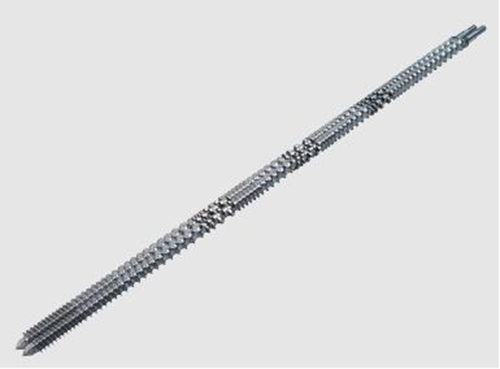
3. The #extruder’s screw and barrel are combined.There are many types of threaded elements, including conveying elements, kneading elements, shearing elements, reverse threaded elements and pressurized threaded elements, each of which plays a different role. According to the needs of material processing, various components are combined by building blocks, and through optimized design, it can be adapted to the processing of various process formula materials.
Basic principles of #extruder’s screw combination
For a twin-screw #extruder, the screw is mainly divided into feeding section, melting section, mixing section, exhaust section and homogenization section.Threaded components mainly include conveying, melting, shearing, material mixing, residence time control and other functions.The threaded components of the twin-screw extruder are combined in a “building block” manner. In practice, they can be adjusted according to different production needs. Therefore, the screw combination is the key to the customization of the twin-screw extrusion process.
1. Large-lead threads should be used at the feeding port to ensure smooth cutting.
2.In the melting section, a small lead thread should be used to establish the pressure, so as to compress and melt the material. A kneading block with a misalignment angle of 90° can be set to balance the pressure, and a kneading block with a misalignment angle of 30° can also be used to initially distribute and mix the material. The kneading block should be set from the middle of the melting section, and the kneading blocks should be arranged at intervals.
3.In the mixing section, it is mainly for the purpose of cutting, refining and dispersing material particles. The setting of threaded elements in this section is very complex and requires designers to have rich practical experience.In this section, kneading blocks with staggered angles of 45° and 60° are mainly used to strengthen the shear, and special elements such as toothed elements or “S”-shaped elements are used to assist. However, it should be noted that the kneading and shearing elements should not be set too much, nor should they be arranged too tightly, so as not to cut too strongly.In addition, in order to enhance the conveying capacity of the material in this section, threaded conveying elements should also be configured at intervals, that is, the kneading block and the threaded conveying elements are staggered with each other.
4.A reverse threaded element or a reverse kneading block should be set before the exhaust port or vacuum port, a large lead threaded element should be set at the exhaust port or vacuum port, and a small lead threaded element should be set after the exhaust port or vacuum port.
5.In the homogenization section, the thread lead should be gradually reduced to achieve supercharging and reduce the length of the back pressure section. At the same time, attention should be paid to the use of single-head threads and wide screw-edge threads to improve the discharge capacity and avoid material leakage.
Table of Contents

With nearly 20 years in the intelligent extrusion equipment industry, he has held key roles at Jwell Machinery, including General Manager and Rotating Chairman. Since 2024, he has managed multiple subsidiaries, driving business expansion and industrial upgrades, while leading innovation in intelligent manufacturing and global growth.