EN
EN  ES
ES PT
PT SV
SV DE
DE TR
TR FR
FR RU
RU VN
VN ID
ID UZ
UZ MX
MX IN
IN
Drip irrigation belts are currently the most effective form of water-saving irrigation in arid and water-scarce areas, with a water use rate of up to 95 per cent. Drip irrigation has higher water saving and yield increasing effect than sprinkler irrigation, and it can be combined with fertiliser application to improve the fertiliser efficiency by more than double. It can be applied to fruit trees, vegetables, cash crops and greenhouse irrigation, and it can also be used for field crop irrigation in dry and water-scarce areas.

Drip irrigation tape is developing rapidly in our drip irrigation technology, so it is very important to know about drip irrigation tape.
Drip irrigation tape is the use of plastic tubing (drip irrigation pipe lead) channel will be water through the diameter of about 10mm capillary or drip head on the orifice to the crop roots for local irrigation. It is through the outlet orifice is very small into the drip head or drip irrigation tape, the water drop by drop evenly and slowly drip in the soil near the crop roots.
Drip irrigation tapes are divided into patch type drip irrigation tapes, embedded cylindrical drip irrigation tubes, labyrinth type drip irrigation tapes, and blue track drip irrigation tapes.
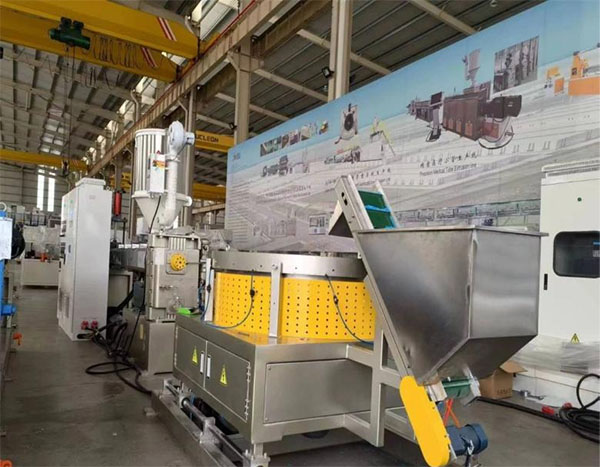
Patch drip irrigation tape features
● Inset drip head with its own filter window, good anti-clogging performance.
● Turbulent flow runner design. Uniform irrigation.
● Strong integrity of drip head and pipeline.
● Flexible adjustment of drip head spacing, wide range of application.
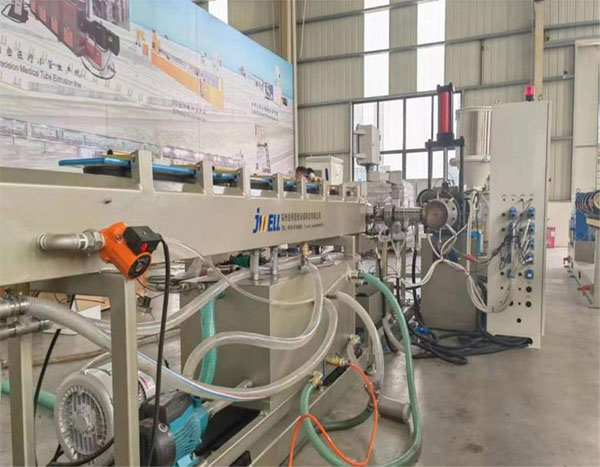
Drip irrigation tape production equipment is mainly single-screw extruder (main machine), auxiliary machines and winders. The basic structure of single-screw extruder is: transmission device, feeding device, barrel, screw, head and die and other five parts.
Transmission device. That is, the driving part of the screw drive, usually by the motor, reducer mechanism and bearings, etc., in the stable extrusion process, the screw speed must be maintained at a constant level to prevent fluctuations in the amount of extrusion, in order to meet the different production requirements, the screw should be driven at variable speeds, the extruder's transmission device is generally used stepless variable speed.
Filling device. The charging device generally adopts a conical charging hopper, with a cooling water jacket around the charging port to remove the heat from the high-temperature barrel to the hopper in order to prevent the plastic from heating up in the charging port and bonding, resulting in uneven charging or blocked material flow.
Barrel is one of the main parts of the extruder, plasticising and pressurising processes are carried out in it, the pressure inside the barrel during extrusion can reach 30~50Mpa, the temperature is generally 150~300℃, and there are partitioned heating and cooling devices inside the barrel.
Screw is the key component of the extruder, due to the rotation of the screw, the barrel of the plastic to move, get the pressure and part of the heat, the screw geometry parameters of the screw has a significant impact on the performance of the screw, the main parameters of the screw: screw diameter, aspect ratio, compression ratio, etc., and now the drip irrigation extruder screw is mainly for the diameter of 40, 50mm, aspect ratio of about 30: 1~40: 1.

Head and mouth mould. The head is the excessive part between the mouth mould and the barrel, and the mouth mould is the forming part of the product section, which is fixed on the head by bolts or other methods. Whether the head and the mouth mould are reasonable or not has a great influence on the output and quality of the products, and the size is determined according to practical experience or rheological knowledge. Auxiliary machines, auxiliary machines are mainly forming moulds, traction machine and parameter control system. Its main role is product forming, product cooling, product parameter control. Winding machine, mainly for product winding into finished products, and record the number of metres.
Plastic from the hopper into the barrel, with the rotation of the screw is gradually pushed to the head direction, in the charging section of the material is gradually compacted, when the material enters the compression section, due to the gradual shallowness of the threads, and due to the screen right-angle runner and the mouth of the mould and so on the resistance, so that the material in the formation of a great deal of pressure.
The material is gradually compacted, at the same time in the barrel of the outer heating and the internal screw and the barrel wall of the material mixing shear generated by the shear heat, the temperature of the plastic is gradually increased, about one-third of the compression section, began to reach the viscous temperature, the more the direction of extrusion to the head, the amount of melted material is gradually increased, and the amount of non-molten material is gradually reduced, about at the end of the compression section, all the material melted and the viscous state, but the melt is not melted.
About the end of the compression section, all the material melts and turns into viscous state, but at this time, the temperature of each point is still very uneven. After the homogenising section of the homogenising effect, the screw will melt the material into the head at a fixed pressure, quantity and temperature.
The mouth mould in the machine head is a forming part, the material through the mouth mould in the machine head to form a certain cross-section of the geometric shape and size, and then through the forming wheel on the vacuum forming, cooling, cutting and so on to get the complete product.
Table of Contents

With nearly 20 years in the intelligent extrusion equipment industry, he has held key roles at Jwell Machinery, including General Manager and Rotating Chairman. Since 2024, he has managed multiple subsidiaries, driving business expansion and industrial upgrades, while leading innovation in intelligent manufacturing and global growth.