EN
EN  ES
ES PT
PT SV
SV DE
DE TR
TR FR
FR RU
RU VN
VN ID
ID UZ
UZ MX
MX IN
IN
Polyethylene (PE) is one of the plastics that has attracted the most attention in industrial production. It has the advantages of excellent low temperature resistance, resistance to most acid and alkali corrosion, good chemical stability, fast molding and strong operability. It is widely used in packaging, Building materials, automobiles, biology and other fields.However, its further application is limited by its shortcomings such as poor heat resistance and relatively low mechanical properties.
Ultrafine CaCO3 has small particle size and good dispersion. It has the advantages of reducing pores and voids in plastics and making the shrinkage of plastics more uniform. It is filled in polyethylene, polystyrene, polyvinyl chloride, and polypropylene. Among other plastics, it can improve the hardness, dimensional stability and rigidity of plastic products.
However, a large number of studies have shown that only using calcium carbonate or other fillers to fill modified polymers or modify other materials often does not achieve the best results, and the performance improvement is relatively simple.The compound modification of various non-metallic mineral powders often has better effects and can improve the overall performance of materials. Now there are more and more research applications.
Research by Yang Changyou and others has shown that nano-CaCO3 can improve the compatibility and thermal stability of polyethylene composite materials, and bagasse fiber (BF) can improve the crystallinity and toughness of composite materials. Both can effectively improve the mechanical properties and mechanics of composite materials. performance.
01 Classification of polyethylene PE
PE is divided according to its chemical structure, relative molecular weight and polymerization method. It can be mainly divided into three categories: low density polyethylene (LDPE), high density polyethylene (HDPE) and linear low density polyethylene (LLDPE).
▷Low-density polyethylene
LDPE has a wide relative molecular weight distribution, low crystallinity, and is sensitive to shear thinning behavior. It can produce strain hardening during the molding process, so LDPE has good optical properties and processability.Because the Young's modulus of the crystalline region is much higher than that of the amorphous region, the rigidity and tensile strength of LDPE are lower, but the toughness and elongation at break are higher.
LDPE is mainly used in plastic packaging bags, agricultural films, injection molded products, etc.
▷High-density polyethylene
HDPE pipe extrusion line has high toughness, rigidity, and mechanical properties, but it is easy to age and deform, and its surface hardness is low.HDPE can be used in pipes, injection molding, blow molding, fishing nets, ropes, packaging films and other products. HDPE has good insulation and can be used as wrapping material for wires and cables, as well as some home appliance casings.
▷Linear low density polyethylene
LLDPE is a new type of polyethylene that has been newly developed and developed rapidly in recent years. It is a copolymer of ethylene and an olefin.Compared with low-density polyethylene, linear low-density polyethylene has similar appearance, good surface gloss, better low temperature resistance, but poor transparency.LLDPE currently penetrates into almost all traditional polyethylene markets, including film, molding, pipe and wire and cable.
02 Modification of polyethylene PE
Single polyethylene has mechanical properties such as insufficient heat aging resistance, brittleness in low temperature environments, low hardness, and poor impact resistance. Therefore, the modification treatment must be targeted.
At present, the modification of PE mainly includes two modification methods: chemical modification and physical modification. In physical modification, filling-enhanced modification is a blend or composite material prepared by adding modifiers to polyethylene and mixing to improve certain properties of polyethylene or give polyethylene new properties.
Currently commonly used inorganic fillers mainly include calcium carbonate, quartz powder, wood flour fiber, rice straw/sugar cane fiber, silica, whiskers, glass fiber, kaolin, glass beads, talc, graphite, carbon nanotubes, etc. By adding this type of reinforcing filler to polyethylene, costs can be reduced and the rigidity, strength, dimensional stability, heat resistance, magnetism, conductivity and other properties of the product can be improved.
Exploring its principle, inorganic particles have high heat resistance and strength, and inorganic particles have a great influence on the crystallization process of polyethylene. As inorganic nucleating agents, they can directly affect the strength, stiffness and heat resistance of polyethylene resin and other key indicators.
03 Calcium carbonate modified
Calcium carbonate, as a versatile inorganic filler, has two disadvantages when used with polymer materials:
On the one hand, the surface is hydrophilic and oleophobic, with strong polarity, contrary to the hydrophobic and oleophilic low polarity of the organic body, it is difficult to combine with the polymer matrix;
On the other hand, calcium carbonate has poor binding force with polymers and can only play a solubilizing role. Excessive calcium carbonate will cause a significant decline in the performance of polymer materials, making it difficult to manufacture and process products.
In practical application, there should be good interfacial bonding between calcium carbonate and polyethylene, and the particle size of calcium carbonate should be small and the dispersibility should be good. Therefore, calcium carbonate must be modified.
Calcium carbonate is modified with titanate coupling agent. The alkyl moiety in the coupling agent is easy to hydrolyze and combine with -OH on the surface of calcium carbonate during the modification process, which can make the surface property of calcium carbonate become hydrophobic; The three structures can be entangled or chemically combined with the polymer, thereby improving the interfacial compatibility between calcium carbonate and the polymer and the rheology and dispersion stability of calcium carbonate in the system, thereby improving the mechanical properties and mechanical properties.
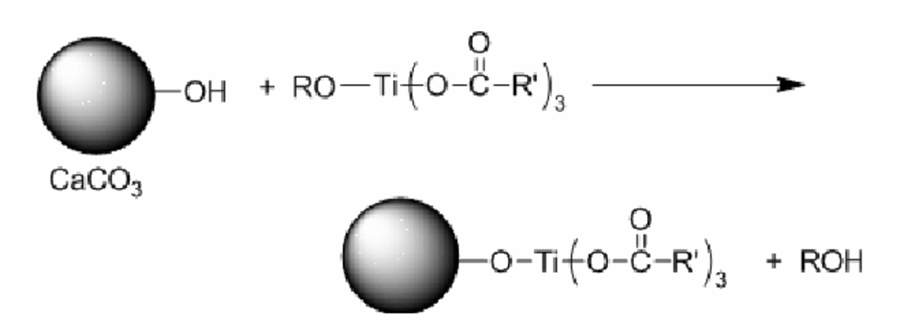
Modification principle of titanate coupling agent
04 Inorganic powder filled modified polyethylene
Zuo Yinze et al. respectively used titanate coupling agent (KH101) and silane coupling agent (KH570) to modify CaCO3 and SiO2 as fillers, and made binary and ternary PE composite materials with HDPE as the matrix.The research shows that: the dispersion of modified nanoparticles in the matrix is improved, the agglomeration phenomenon is reduced, and the tensile strength and impact strength of binary composites increase first and then decrease with the increase of CaCO3 and SiO2 content. When the doping amount of SiO2 is 7wt%, the comprehensive performance of PE/SiO2 composite material is the best; when the doping amount of CaCO3 is 15wt%, the comprehensive performance of PE/CaCO3 composite material is the best.In PE/CaCO3/SiO2 composite materials, when the doping amounts of calcium carbonate and SiO2 are 25wt% and 7wt%, the tensile strength and notched impact strength increase by 17.6% and 34.5% respectively, ensuring a synergistic effect and achieving better results. Overall performance.
Zhou Lin and others developed high-performance composite materials with nano-calcium carbonate blended with SBS/HDPE. The research showed that: the impact strength, tensile strength, and elongation at break of nano-calcium carbonate and SBS/high-density polyethylene blends increased with the increase of nano-calcium carbonate. The changes in mass fraction all show a parabolic change with an opening downward. Since the impact properties, tensile strength, and elongation at break of the blends basically change synchronously, it can be concluded that nano-calcium carbonate can both toughen and strengthen the blends. The overall performance of the blend is optimal when the mass fraction of nano-calcium carbonate reaches 15% of the total mass of the blend.
Zhang Xiaoqian et al. compounded different proportions of CaCO3 whiskers with wood flour and HDPE to prepare CaCO3/HDPE/wood flour composite materials. Their research shows that when the doping amount of CaCO3 is 7%, the tensile strength reaches a peak value of 28.3MPa. Compared with HDPE/wood powder composite material (19.7MPa), it is increased by 43.7%, while the bending and impact strength are increased by 19.2% and 20.1%.

With nearly 20 years in the intelligent extrusion equipment industry, he has held key roles at Jwell Machinery, including General Manager and Rotating Chairman. Since 2024, he has managed multiple subsidiaries, driving business expansion and industrial upgrades, while leading innovation in intelligent manufacturing and global growth.