EN
EN  ES
ES PT
PT SV
SV DE
DE TR
TR FR
FR RU
RU VN
VN ID
ID UZ
UZ MX
MX IN
IN
What issues should we pay attention to during sheet machine production operations?
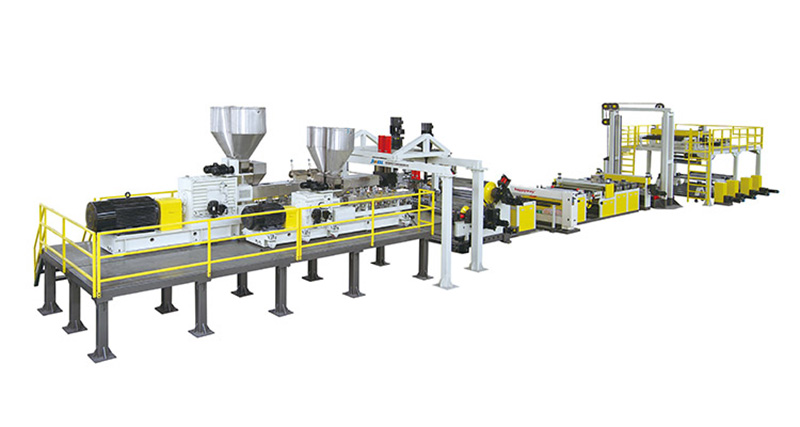
(1)The temperature of each section of the barrel of plastic sheet production equipment gradually increases from the feeding section to the connection between the barrel and the forming mold.
(2)The mold temperature is slightly higher than the barrel temperature. The higher temperature is controlled at 5---10℃. The temperature at both ends of the mold is slightly higher than the temperature in the mold, and the higher temperature is controlled at 5-10°C.
(3)In the form of sheet insertion, the upper surface of the middle roller of the three-roller should be on a horizontal plane with the lower plane of the mold lip; the end surface of the lip should be parallel to the center line of the middle roller, 50~100mm apart.
(4)The gap between the mold lips should be slightly less than or equal to the thickness of the plate product, and the gap in the middle of the mold lips should be slightly smaller than the gap between the end lips on both sides.
(5)Note that the roughness R of the three-roller working surface should not be greater than 0. 2pm. When cleaning the roller surface, do not use a hard steel knife to scratch the roller surface. A copper knife should be used to clean the remaining material on the roller surface.
(6)The roller surface should have some medium height; the gap between the three rollers should be equal to or slightly larger than the thickness of the plate.
(7)The temperature control of the mold must be stable. When the temperature is high, the melt flows in the mold faster; when the temperature is low, the melt flows in the mold slower. Unstable melt flow rate will cause large longitudinal thickness errors of plate (sheet) products.
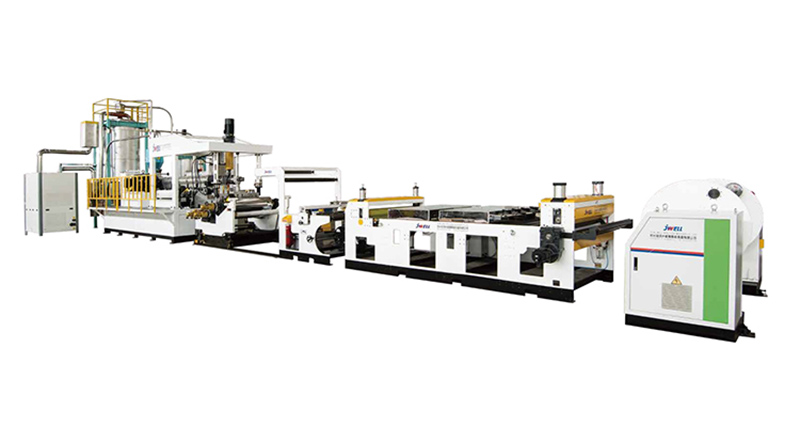
(8)Pay attention to controlling the working surface temperature of the three rollers. The temperature of the film entering roller should be slightly higher and the temperature of the film exit roller should be slightly lower. If the temperature of the roller surface is too high, the slab will not be easily removed from the roll, and horizontal lines will easily appear on the surface of the product; if the temperature is too low, the surface of the product will be dull. According to this phenomenon, the roller surface temperature control should be adjusted in time.
(9)The operating speed of the three rollers is slightly higher than the extrusion speed of the slab from the die mouth, and the speed difference generally does not exceed 10%. The working speed of the three rollers must be controlled smoothly. Too fast or too slow running speed will have a great impact on the thickness error of the plate.
(10)When extruding polyolefin plastics to form plates (sheets), the screw adopts a mutation structure, the compression ratio is (3-4): 1, and the melt flow rate is: HDPE 0.3~2.0g/10min, LDPE 0.1~ 0.3g/1Omin, PP 0.5~1. 5g/10min. For non-crystalline polymer resin extrusion molding boards (sheets) such as ABS, a gradient screw should be used, with a compression ratio of (1.6 to 2.5): 1.
(11)In the extrusion molding of plastic plates (sheets), except that polyvinyl chloride, polyethylene and polypropylene resins generally do not undergo dehumidification treatment before extrusion, some other plastics (such as ABS, polyamide, etc.) should be dehumidified before extrusion. Dehumidification and drying are required. Otherwise, a vented extruder should be used for extrusion molding.

With nearly 20 years in the intelligent extrusion equipment industry, he has held key roles at Jwell Machinery, including General Manager and Rotating Chairman. Since 2024, he has managed multiple subsidiaries, driving business expansion and industrial upgrades, while leading innovation in intelligent manufacturing and global growth.