EN
EN  ES
ES PT
PT SV
SV DE
DE TR
TR FR
FR RU
RU VN
VN ID
ID UZ
UZ MX
MX IN
IN
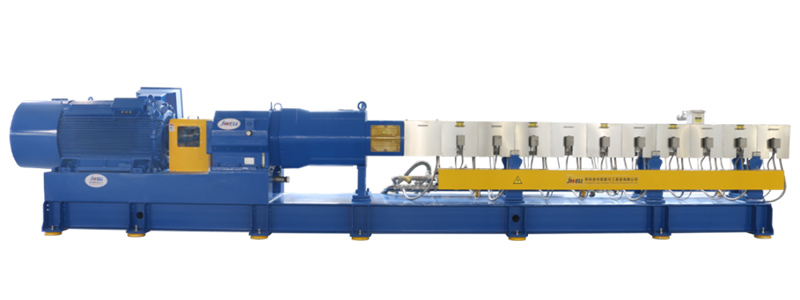
There are many different pelletizing line designs on the market, but all pelletizing lines fall into two main categories: cold pelletizing systems and die face hot pelletizing systems. The main difference between the two is the timing of the pelletizing process. Each of these two pelletizing systems has its own advantages and disadvantages!
Cold cutting system
A cold pelletizing system consists of a die, a cooling zone (air or water-cooled), a drying zone (if water-cooled) and a pelletizing chamber. There are two main types of cold pelletizing systems, i.e. flake pelletizers and strip pelletizers.
a: The molten polymer of the flake granulator flows from the mixing equipment through a belt die or roller refiner to be calendered into polymer flakes of a specified thickness. The flakes are solidified and cooled over a distance during transportation, and then cut into round or square pellets with a pelletizer in a bin.
Chip granulation is a particularly old method of manufacturing granules for a wide range of different polymers from nylon to PVC. Advantages: High output. Accuracy is reported to be quite good, with a granulation capacity of up to 1,843.69 kg/h. This is a cold-cutting granulation method, and the noise emission is higher than the method of cutting granules from molten polymers. Solidified cutting polymers have shorter cutter life and powder generation is often a problem. For some polymers some “grain chain” phenomena can be seen.
b: Strip pelletizers have been in use almost as long as flake pelletizers. It consists of a die, a cooling section (water bath or blower), a drying section (if water-cooled) and a cutting knife. Strips are formed by passing the molten polymer through a horizontally mounted orifice using a machine or gear pump (modern orifices are precision machined and uniformly heated to produce consistent quality strips). Once the strips are discharged from the mold, they are cooled by a blower or air/vacuum facility, or by a water bath. If water cooling is used, the strips pass through a drying section with forced ventilation to remove the moisture and then the strips are sent to the pelletizing chamber. The strips are accurately cut to the required length using the shearing action of a pair of fixed and rotating knives. The granules have a diameter of 3.175 mm and a length of 3.175 mm with well defined corners.
c: The traditional method of drawing strips involves stretching the strips through a cooling section (commonly a water bath), which sometimes results in falling or inconsistent dimensions of the strips. This is common in polymers with poor melt strength, such as polypropylene, polyester and nylon. When a strip falls, the material is scrapped, so operators need to pay close attention. If the strips are drawn inconsistently, downstream pellets need to be sieved.
Other modes of strip formation can be accomplished without close operator supervision by using a motor-driven slotted infeed conveyor that supports and splits the strips from the die to the pelletizer. The strips conveyed by this type of spinning force are more uniform in size, do not fall, and are therefore less likely to be scrapped. Some of these methods can have a production capacity of 6803.89 kg/h, compared to about 1814.37 kg/h for the stretching method, since the operator can only supervise a limited number of strips.
Strip lines are inexpensive, easy to operate and easy to clean. This has advantages for color blending, since the changeover of two different batches of color requires a thorough cleaning of the equipment. However, the disadvantage of the strip method is the space required for the cooling section, the length of which is determined by the temperature requirements of the polymer.
Die Face Thermal Cutting System
There are three basic types of die-surface thermal cutting systems, namely spray granulators, water-jet (water ring) granulators and underwater granulators. Although such systems can be of different designs, a typical system consists of an orifice die, a cutting chamber, a motorized rotary lobe knife, a cooling medium, and a method of drying the granules (if water cooling is employed).
The orifice mold is an important part of the die face thermal pelletizing system. It is mounted vertically or horizontally and is usually heated by oil, steam, or a cartridge or band heater. Electric heat is usually used for smaller dies; however, larger dies are usually heated with steam or oil. Die construction materials vary, but regardless of the material or heating medium used, the die orifice diameter needs to be uniform; there needs to be enough heat to maintain the polymer temperature throughout the process; and the rotating die surface against which the pelletizing knife rotates needs to be tough and smooth - all of which are required to produce a uniform pellet.
As the molten polymer is orificed into the mold, the pelletizing knife, which rotates at a very high speed, cuts it into pellets. Typically, the knife is either in contact with or very close to the mold surface. Once the pellets have been cut, they are thrown away from the knife by centrifugal force and transported to the cooling medium. The size, shape, material and mounting of the knife can vary. In some systems, the knife is spring loaded to automatically adjust the distance between the knife and the die; in other systems, the distance between the knife and the die is adjusted manually. Since knife life depends on the accuracy of knife-to-die alignment, the abrasiveness of the polymer, and the aggressiveness of the operator, cutting polymer pellets in the molten state is desirable.
a: Spray granulators are recommended for polymers that are sensitive to heat and long residence times, such as PVC, TPR and cross-linked polyethylene. Pelletizing rates up to 4989.52 kg/h are required to keep the flow path of the polymer from the machine to the pelletizing chamber as short as possible and to use a small amount of heat. As the polymer passes through the die, the rotational force of the rotating die surface cuts it into pellets. Once the pellets are cut, they are thrown away from the rotating knife and captured by the air that is forced to circulate in the specially designed pelletizing chamber. The air stream initially quenches the surface of the pellet and carries it out of the chopping chamber and into the cooling zone.
Fluidized bed dryers are often used to cool the pellets. The pellets are slid down an adjustable ramp and a circulating fan blasts air through the pellets. Adjusting the inclination of the ramp can lengthen or shorten the residence time of the granules in the dryer. Another common cooling method is to unload the pellets from the cutting chamber into a water tank and remove the water in a fluidized bed dryer or centrifugal dryer.
b: Water-jet granulators, suitable for most polymers except those with low melt viscosity or viscosity. These machines, also known as water ring pelletizers, have a pelletizing rate of 13,607.77 kg/h.
The molten polymer is cut into granules from a hot orifice die by a rotating knife that rotates against the die surface. The special feature of this pelletizing system is the specially designed water jet pelletizing chamber. The water flows in a helix until it exits the chamber. Once the pellets are cut, they are thrown into the water stream for initial quenching. The pellet water slurry is discharged into a pellet slurry tank for further cooling and is then fed into a centrifugal dryer to remove the water.
c: The underwater pelletizer is similar to the spray pelletizer and the water jet pelletizer, except that it has a smooth stream of water flowing over the die surface, which is in direct contact with the die surface. The size of the pelletizing chamber is just large enough to allow the pelletizing knife to rotate freely across the die surface without restricting the flow of water. The molten polymer passes through the die, the rotating knife cuts the pellets, and the pellets are carried out of the pelletizing chamber by tempered water into a centrifugal dryer. In the dryer, the water is discharged back into the storage tank, cooled and recycled; the pellets pass through the centrifugal dryer to remove the water.
Underwater pelletizer needs to use the mouth mold with even heat distribution and special heat insulation facilities. Small pelletizing knives are electrically heated; large pelletizing knives require oil- or steam-heated orifices. Process water is routinely heated to higher temperatures, but not hot enough to adversely affect the free flow of the pellets. Underwater granulators are used for most polymers and some models are capable of achieving a granulation capacity of 22,679.62 kglh. The manner in which the water flows over the die surface of the orifice is a major advantage when used for pelletizing low viscosity or cohesive polymers, but for some polymers such as nylon and some brands of polyester this feature may cause the orifice to freeze. Other advantages include: lower noise emission because pelletizing is done in the molten state and the water acts as a sound barrier; and fewer changes of pelletizing knives compared to cold cutting systems.
Table of Contents

With nearly 20 years in the intelligent extrusion equipment industry, he has held key roles at Jwell Machinery, including General Manager and Rotating Chairman. Since 2024, he has managed multiple subsidiaries, driving business expansion and industrial upgrades, while leading innovation in intelligent manufacturing and global growth.