EN
EN  ES
ES PT
PT SV
SV DE
DE TR
TR FR
FR RU
RU VN
VN ID
ID UZ
UZ MX
MX IN
IN
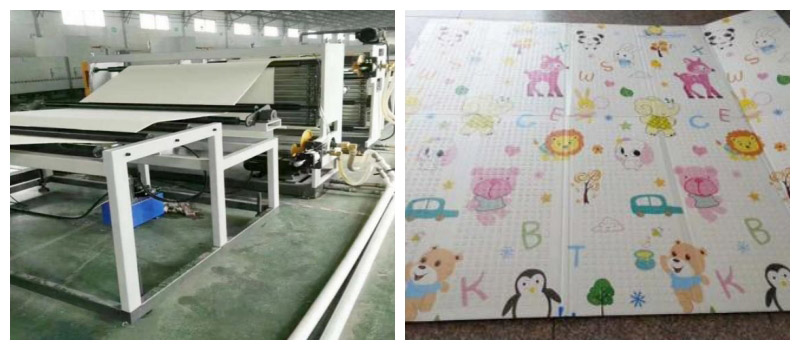
In the polymer foam industry, XPE (chemically cross-linked polyethylene foam) and IXPE (radiation-cross-linked polyethylene foam) have become key materials in modern industry and consumer goods, thanks to their excellent closed-cell structure. XPE/IXPE foam sheet production lines, the core equipment supporting the large-scale, high-quality production of these materials, have established an irreplaceable value proposition across multiple industries thanks to their flexible process adaptability and stable performance. Their applications span the entire supply chain, from basic industries to high-end manufacturing, and their technological advantages highlight the development direction of modern foaming equipment.
Main Applications of XPE IXPE Foaming sheet extrusion line
Automotive industry:
Production lines are responsible for the customized production of high-end interior materials. To meet the sound insulation and comfort requirements of different vehicle models, production lines can adjust material density and pore size. For example, IXPE sound insulation mats produced for luxury models utilize a uniform closed-cell structure formed by electron irradiation, reducing interior noise by 3-5 decibels. XPE seat padding for economy cars uses a chemical cross-linking process to achieve a balance between cost and support. These materials are also used in key areas such as door seals and instrument panel cushioning, becoming a core component in optimizing vehicle NVH (noise, vibration, and harshness) performance.
Packaging industry:
The packaging industry is a traditional primary application area for the production line. To protect fragile items such as electronics and precision instruments, the line can produce cushioning sheets with thicknesses ranging from 0.5 to 50mm. The IXPE lining used for smartphone transportation, with its smooth surface and fine pore size, protects against scratches while withstanding drops from a height of 1.5 meters. The XPE coil used for glass packaging reduces transportation losses to less than 0.1% thanks to its excellent elastic recovery. In cold chain logistics, the line's customized high-density XPE insulation panels can extend the cold-keeping time of refrigerated containers to over 48 hours.
In addition, the production line provides core materials for yoga mats, protective gear and other products in the sports and leisure field, produces wheelchair cushions and surgical sheet base materials in the medical and health field, and supplies anti-static foam lining materials in the electronics manufacturing field, forming a "one-line multi-functional" material supply pattern.
Technical advantages
The core competitiveness of the XPE/IXPE foam sheet production line stems from its precise control of two cross-linking processes and the coordinated optimization of the equipment system. Its specific advantages are reflected in four dimensions.
The line's most prominent advantage is its strong process adaptability. The equipment can flexibly switch between chemical cross-linking and electron beam cross-linking modes. When producing XPE, the precise addition of DCP cross-linking agent and AC foaming agent, combined with the mixing process in a 35-55L internal mixer, enables cost control for mass production. When switching to IXPE production, the chemical additive system is disabled and the electron beam irradiation module is activated. The cross-linking degree is controlled by adjusting the irradiation dose (typically 50-200kGy) to meet the needs of high-end applications. This switchover takes only 2-3 hours, significantly improving the company's responsiveness to market demand.
The balance between environmental protection and efficiency embodies the development philosophy of modern equipment. In XPE production, an additive recovery system increases crosslinker utilization to over 95%, reducing volatile emissions. IXPE production utilizes physical crosslinking, completely eliminating chemical additive residues and meeting EU REACH and US FDA environmental standards. In terms of production efficiency, high-end production lines boast extrusion speeds of up to 30m/min, with a single line boasting a monthly production capacity of up to 500 tons, achieving a win-win situation for both environmental protection and profitability.
With the development of new energy and high-end manufacturing industries, production lines are being upgraded to become more precise, environmentally friendly, and intelligent. These include the introduction of AI-powered visual inspection systems for automated defect detection, a servo drive system that reduces energy consumption by 30%, and the development of low-temperature foaming processes to further enhance material performance. This production line, combining process flexibility with stable performance, is poised to demonstrate its value in even more emerging fields.


With nearly 20 years in the intelligent extrusion equipment industry, he has held key roles at Jwell Machinery, including General Manager and Rotating Chairman. Since 2024, he has managed multiple subsidiaries, driving business expansion and industrial upgrades, while leading innovation in intelligent manufacturing and global growth.