EN
EN  ES
ES PT
PT SV
SV DE
DE TR
TR FR
FR RU
RU VN
VN ID
ID UZ
UZ MX
MX IN
IN
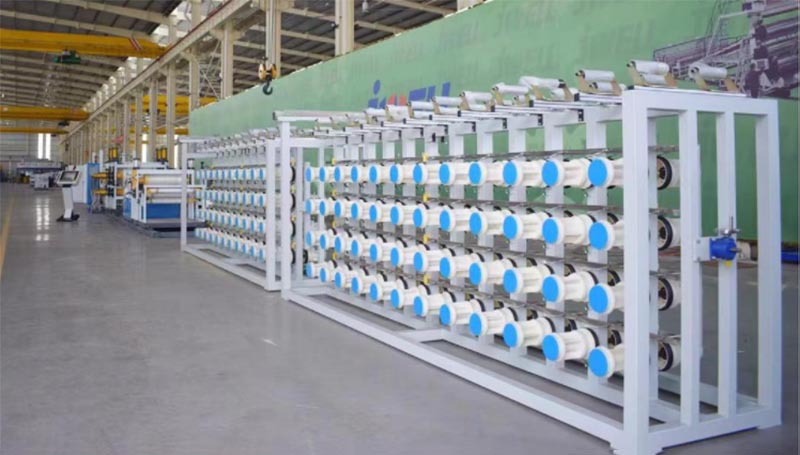
PP+ glass fiber impregnated CFRT sheet extrusion line is a extrusion line of glass fiber wire and PP resin composite sheet.After winding, the glass fiber wire is heated and enters the mold inside with the fused PP resin into the three-roll calendering machine. After cooling and shaping, the product with the required thickness is made and finally the stress is removed.The PP glass fiber plate extruded by this equipment has the characteristics of good rigidity, ultra-high temperature resistance, ultra-low warpage, high flame retardant, etc. It can replace the engineering plastics with high physical properties in many applications, and has a very high application cost performance.
Continuous glass fiber reinforced thermoplastic composite (CFRT) strip/sheet extrusion line is a new type of composite material with high strength, high modulus and corrosion resistance after glass fiber, carbon fiber and other fibers are completely soaked in thermoplastic resin.
Glass fiber reinforced features
1)After the glass fiber reinforcement, the glass fiber is a high temperature resistant material, so the heat resistance temperature of the reinforced plastic is much higher than before without the glass fiber.
2)After glass fiber reinforcement, due to the addition of glass fiber, the mutual movement between the polymer chains of plastics is limited,so the shrinkage rate of reinforced plastics in CFRT glass fiber wetted sheet extrusion line is reduced a lot, and the rigidity is also greatly improved.
3)After glass fiber reinforcement, PP plastic will not stress crack, and at the same time, the impact resistance of PP is improved a lot.
The main uses of glass fiber:untwisted roving for winding
In order to produce different thickness of glass steel extrusion pipe, storage tank winding method came into being. For winding without twist roving, must have the following characteristics.
1)It must be easy to band, usually to ensure a flat ribbon.
2)Since the general untwisted roving is prone to the phenomenon of falling off the loop when it is withdrawn from the yarn barrel, it is necessary to ensure that its disintegration is better, and the silk produced can not be chaotic like a bird's nest.
3)Tension can not fluctuate, and can not occur overhang phenomenon.
4)The linear density requirement for untwisted roving is uniform and less than the specified value.
5)In order to ensure that it is easy to infiltrate when passing through the resin tank, it is required that the penetration of the untwisted roving is good.
Composite material introduction
Composite material is composed of two or more materials with different properties, through physical or chemical methods, in the macro (micro) composition of materials with new properties.
Various materials complement each other in performance and produce synergistic effect, so that the comprehensive performance of composite materials is better than the original composition materials and meet various requirements.
Properties of composite materials
Fiber reinforced materials are widely used in composite materials.
It is characterized by small specific gravity, large specific strength and large specific modulus. For example: carbon fiber and epoxy resin composite material, its specific strength and specific modulus are several times greater than steel and aluminum alloy, but also has excellent chemical stability, anti-friction wear, self-lubrication, heat resistance, fatigue resistance, creep resistance, noise, electrical insulation and other properties.

With nearly 20 years in the intelligent extrusion equipment industry, he has held key roles at Jwell Machinery, including General Manager and Rotating Chairman. Since 2024, he has managed multiple subsidiaries, driving business expansion and industrial upgrades, while leading innovation in intelligent manufacturing and global growth.