EN
EN  ES
ES PT
PT SV
SV DE
DE TR
TR FR
FR RU
RU VN
VN ID
ID UZ
UZ MX
MX IN
IN
Applications
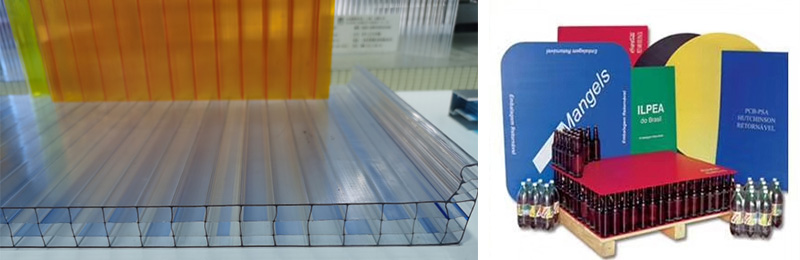
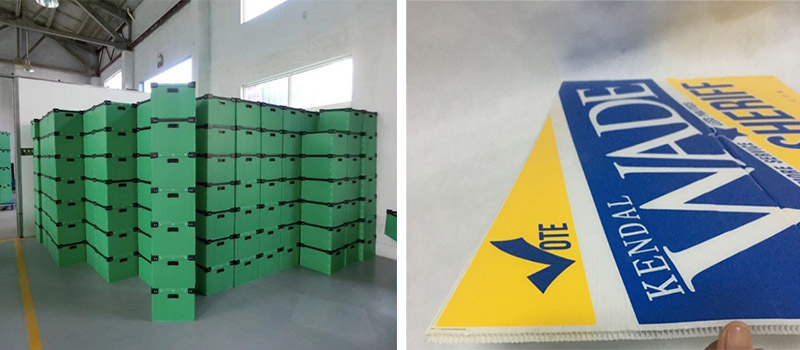
PP hollow cross section plates, known for being lightweight, high-strength, waterproof, moisture-resistant, corrosion-resistant, and recyclable, are widely used across various industries. Common applications include packaging (such as logistics boxes, dividers, and anti-static containers), advertising displays (signboards and exhibition panels), construction (formwork and protective barriers), agriculture (seedling trays and windbreak panels), household and office use (folders and storage boxes), as well as the automotive sector (vehicle compartment partitions). These plates also offer customizable colors, excellent processability, and environmental sustainability through recyclability.
Polycarbonate (PC) hollow plates, commonly known as "sunlight panels" are extensively utilized across various sectors due to their exceptional properties, including high light transmission, impact resistance, thermal insulation, UV protection, and lightweight structure. In agriculture, these panels are ideal for greenhouses, offering optimal light diffusion and insulation to promote plant growth while withstanding harsh weather conditions. In construction, they serve as materials for skylights, canopies, and roofing in residential, commercial, and industrial buildings, providing natural lighting and energy efficiency. Their versatility extends to applications in sound barriers along highways, decorative elements in interior design, and protective covers in industrial settings.
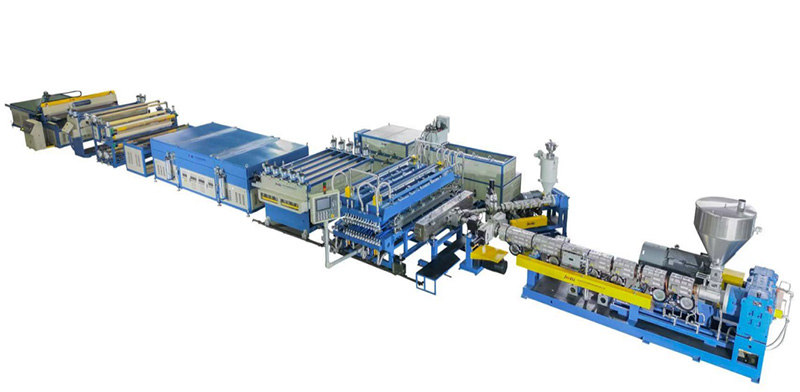
Main Components of the Production Line
● Jwell Single-Screw Extruder: Melts and homogenizes polypropylene (PP) or polycarbonate (PC) pellets, feeding the molten material into the mold for plate formation. Features high-efficiency screw design to ensure excellent plasticization and stable extrusion at high output rates.
● Hydraulic Screen Changer: Filters impurities from the molten material, ensuring product quality. Hydraulic drive allows for quick screen changes, minimizing downtime.
● Metering Pump: Precisely controls the flow rate of the molten material, ensuring uniform sheet thickness. Enhances system stability and production efficiency.
● T-Die (Mold): Uniformly distributes the molten material to form plates of desired width and thickness.Made of alloy steel with high-activity throttling devices to ensure uniform wall thickness.
● Two-Stage Vacuum Calibration Table: Uses vacuum and cooling systems to quickly shape the extruded plate. Equipped with rapid heat exchange cooling systems to ensure precise calibration.
● Haul-Off Unit (Five-Roller): Uniformly pulls the shaped plate, ensuring flatness.
● Annealing Oven: Further heats the sheet to eliminate internal stresses, improving flatness. Large-area conductive heating effectively removes plate stresses.
● Corona Treatment Unit: Treats the plate surface to increase surface tension, enhancing adhesion in subsequent processes.
● Plate Cutter: Cuts the plate to the desired length, ensuring consistent product specifications. accurate instant length cutting and automatic lifting unloading devices for quality cutting edges.
Specifications and Production Capacity
The common specifications for hollow cross section plastic plates (such as PP, PC, PE) are as follows:
● Width: 1220 mm, 2100 mm, 2400 mm, 2600 mm
● Thickness: 2–6 mm (most commonly used)
Jwell Machinery typically utilizes the SJ120/33 single-screw extruder, which offers a maximum extrusion capacity of up to 350 kg/h. For higher production demands, the SJ150/35 or SJ150/36 single-screw extruders can be employed, with maximum extrusion capacities ranging from 450 to 500 kg/h.
It is important to note that these extrusion capacities refer to the output of the molten material and do not directly equate to the final product yield. The actual product output is influenced by various factors, including mold design, cooling system efficiency, and haul-off speeds. Therefore, when selecting an extruder, it is essential to consider the overall configuration of the production line and the specific product specifications to ensure that production requirements are met and efficiency is optimized.
Additionally, Jwell offers a range of single-screw extruders to cater to different production needs. All equipment is manufactured using high-quality materials to ensure long-term stable operation and high performance.
In summary, choosing the appropriate extruder model and configuration is crucial for ensuring the efficient operation of the production line and maintaining product quality. It is recommended to fully consider product specifications, production capacity, and equipment performance during the selection process to achieve the best production outcomes.
Summary
In the production of PP hollow cross section plates, selecting the right extrusion equipment is crucial. As a leading enterprise in the plastic extrusion industry, Jwell Machinery leverages its extensive technical expertise and industry experience to offer a variety of high-performance single-screw extruders, meeting diverse production capacities and product specifications.
Jwell excels not only in providing efficient extrusion main machines, but also in delivering complete, optimized production line solutions. From raw material extrusion and die design to cooling, forming, and cutting, Jwell ensures stable product quality and high production efficiency throughout the entire process.
All Jwell equipment is manufactured with premium-quality materials, ensuring long-term operational stability and durability. Trusted by customers across the industry, Jwell offers customized and efficient configurations for both small-to-medium scale production and large-scale, high-capacity projects.
In summary, choosing Jwell Machinery means more than just choosing a machine—it means choosing a mature, stable, and highly efficient production solution.

With nearly 20 years in the intelligent extrusion equipment industry, he has held key roles at Jwell Machinery, including General Manager and Rotating Chairman. Since 2024, he has managed multiple subsidiaries, driving business expansion and industrial upgrades, while leading innovation in intelligent manufacturing and global growth.